
Photography notes from Tuition Sessions
The Trinity - The Exposure Triangle
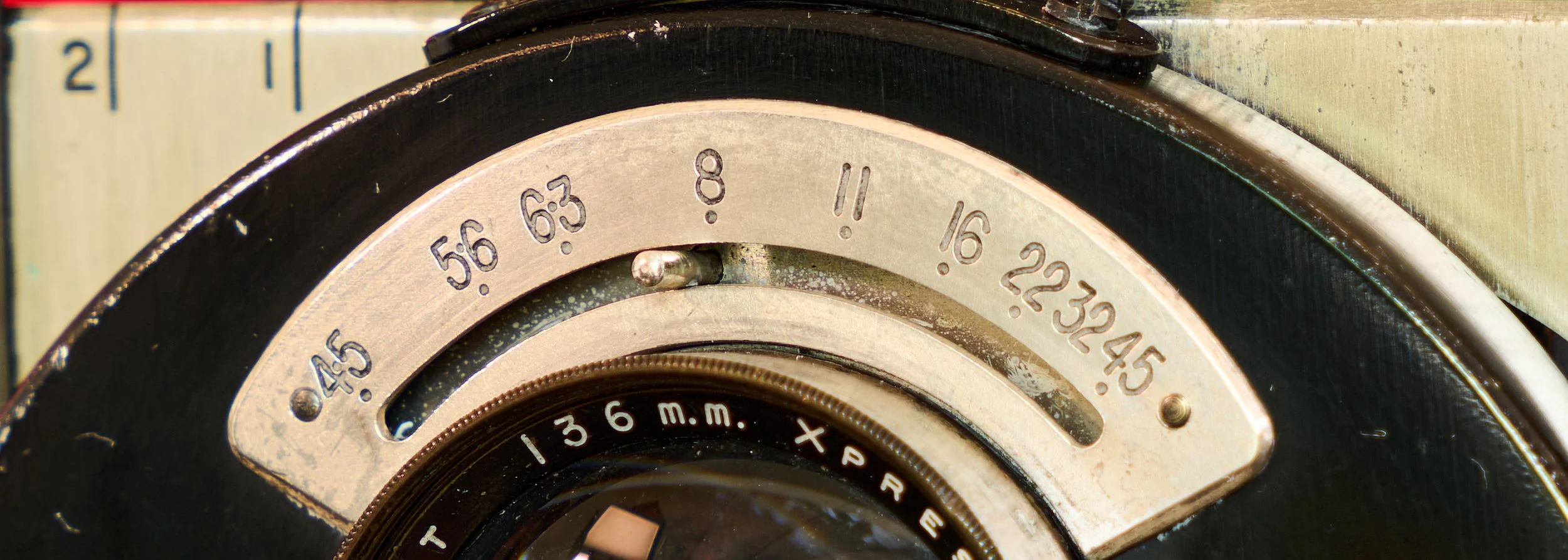
Aperture scale circa 1913 style.
These notes outline the understanding of key elements to achieve the desired and correct exposure for capturing any image; they are ISO (International Organisation for Standardisation), Aperture and Shutter speed. Recognised as The Exposure Triangle.
ISO. This defines the sensitivity to light expressed in numbers. In simple terms a numerical value attributed to film or a sensor. At today’s levels from 50 ISO to beyond 50,000 ISO. Changing the ISO to a higher number will lighten an image as long as the aperture and shutter speed remain the same, lowering will darken. For instance when doubling the ISO - from 50 to 100, the sensor or film requires half the amount of light to achieve correct exposure level as experienced at 50 ISO.
Whilst the camera’s sensor is light sensitive, it also electronically processes light (from the image) reaching it and so a ISO 50,000 does not mean a capacity for increased light sensitivity as a simple reactive stepping process from ISO 50. It is the sensors capacity and ability to process an image as ISO increase to higher levels. This is achieved by gain - electrical signal amplification to the sensor sensels (Photosites) which are commonly referred to as pixels.
Aperture. This is the camera and/or lens control which dictates the amount of light passing through the lens to reach the sensor/film, expressed in terms of f.stops. Light passing through the glass optics of the lens is controlled by blades (diaphragm in optical terms), which interconnect to form a circle. F numbers are commonly referred to as lens speed, an f/1.4 lens would be termed fast (lots of light), whereas a f/4.5 would be referred to as slow lens needing a lower shutter speed for an equivalent image exposure to, for instance that using a f/1.4 lens. The term fully open is when the aperture is set to the manufacturers stated lowest fstop this could be f/1.4, f2.8 or f/4.5. Achieving f stops below f/1.2 is the holy grail of lens manufacture and the price of a lens normally reflects this; lenses with apertures below f/2.8 are generally more expensive than their f/3.5 or f/4.5 counterparts. Simply put f/1.4 means a large opening for maximum light reaching the sensor, whereas f/16 is smaller restricting the amount of light. Whole f/stop adjustments or increments for a modern f/2.8 lens would be f/2.8, f/4, f/5.6, f/8, f/11, f/16, f/22, f/32.
Shutter Speed. This is the duration the camera curtain shutter is open to allow light (reflected from the image) to land on the sensor or film. Expressed in segments of minutes and seconds on the camera controls. The shutter opens and closes at a constant speed, so the term is slightly misleading. Shutter speed should really be duration - the duration of the shutter opening and closing to allow light from the image to fall on the sensor or film. For instance 1/2 a second or 1/2000 of a second. Like aperture a change of setting - say 1/125 second to 1/250 is referred to a stop, in this example 1 stop.
Next posting - Exposure Control.
Nigel Housden October 2026